
Scott County Deed Types
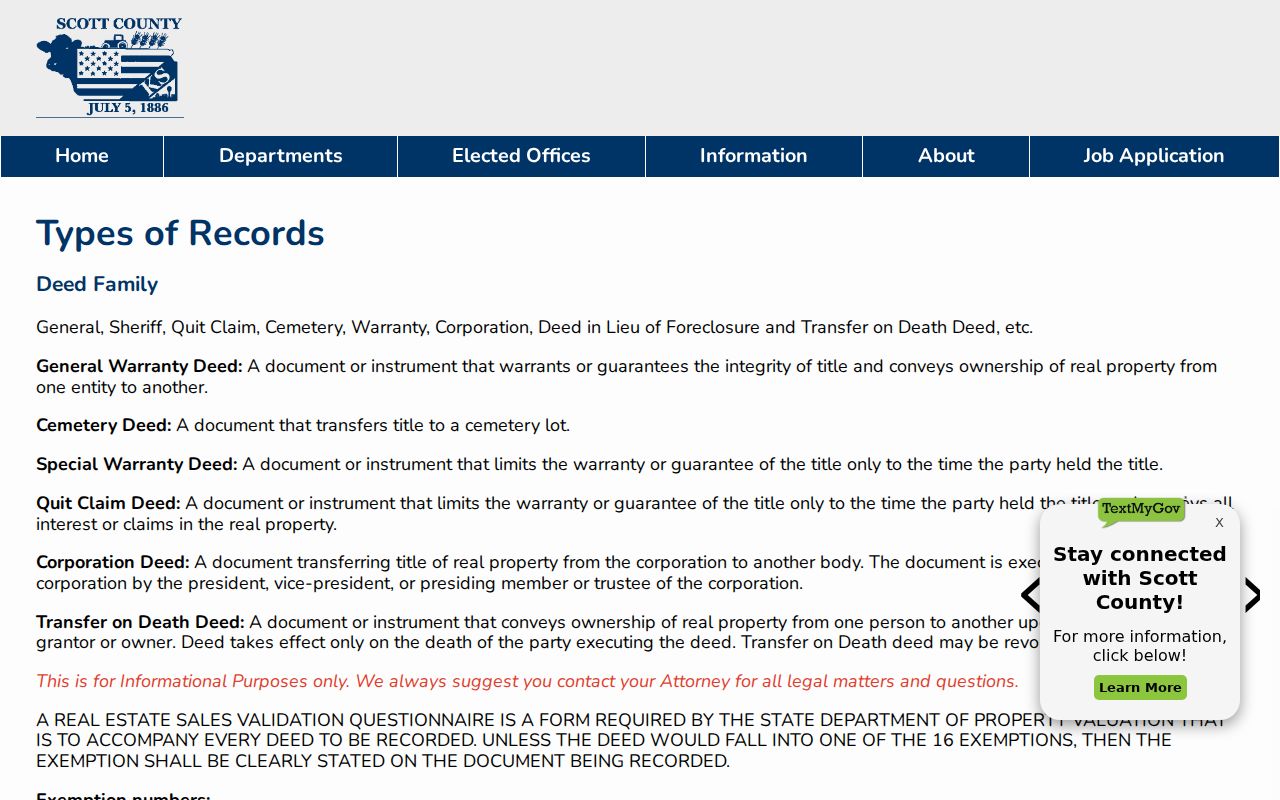
The Scott County recording office accepts a wide range of instrument types. Read every deed closely for its granting language, parties, dates, reservations, and exact legal description. A deed's label only signals the transfer method; the full recorded document controls what it actually means.
| Deed Type | What It Does | Common Use |
|---|---|---|
| Warranty deed | Conveys title with stated warranties | Ordinary sale |
| Quitclaim deed | Conveys the grantor's existing interest without broad warranties | Family, trust, or title cleanup |
| Corporate deed | Transfers an entity's interest through authorized action | Business-owned land |
| Executor or guardian deed | Transfers through an estate or guardianship authority | Probate-related title event |
| Sheriff deed | Records a judicial conveyance | Completed court-directed transfer |
| Transfer-on-death deed | Sets a transfer effective at death | Estate planning |
Mortgages, liens, easements, and releases often sit beside conveyances in the deed records, yet not every instrument transfers ownership. A release closes out a debt. A plat lays out lots. A lis pendens warns of pending litigation over the land. Follow the sequence before drawing any title conclusion.
Request Scott County Deed Records
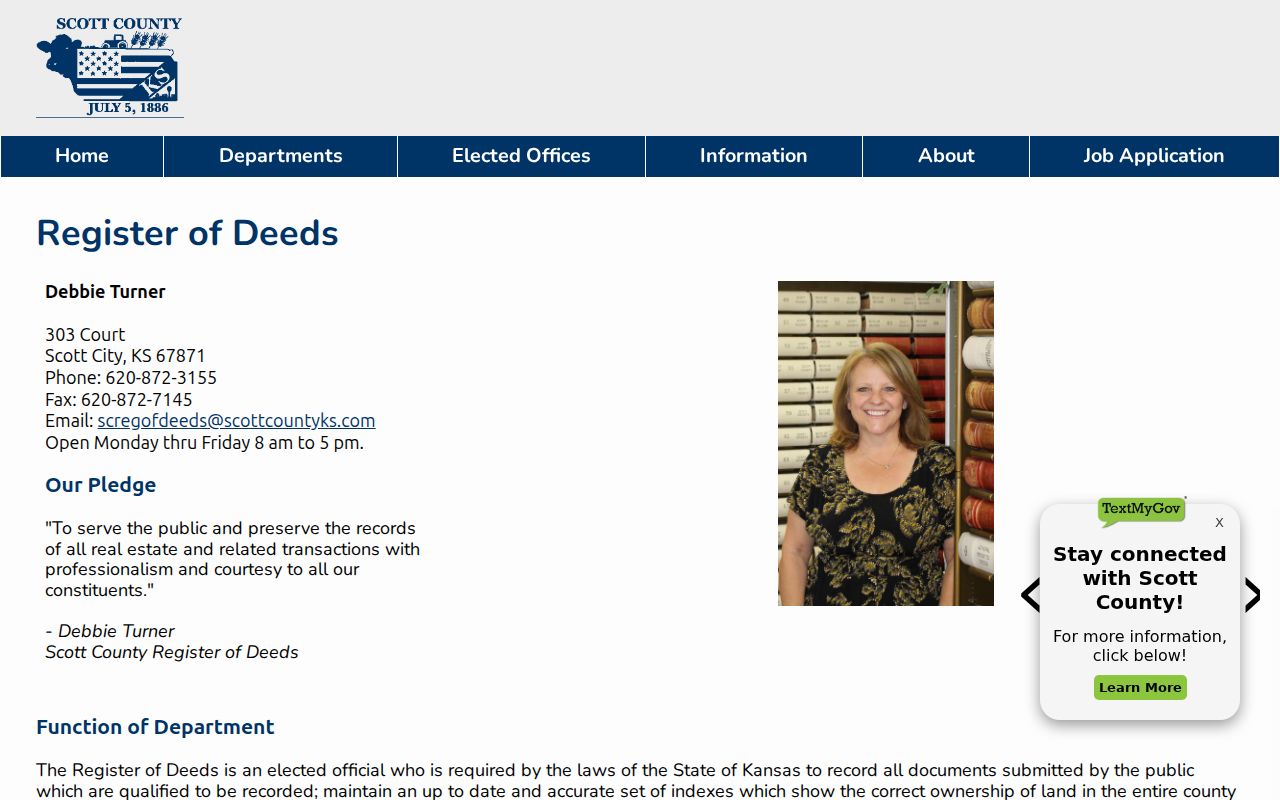
Scott County offers no public grantor-grantee URL or scanned deed-image archive. The recording office at 303 Court Street in Scott City is the dependable route instead. It lists 620-872-3155, scregofdeeds@scottcountyks.com, and hours of 8:00 a.m. to 5:00 p.m. Monday through Friday. Ask for an index search by grantor, grantee, and legal description. Give a date range and likely document type. Counter visits, phone calls, email, and written requests all work when no web index exists. A focused Kansas Open Records Act request can seek existing index entries or copies, though the office need not build a new title history.
The county's recording office overview explains its recording and indexing role.
Walk Scott County's Deed Index
Scott County assigns each recorded document a time, book, and page reference, then indexes it by name and legal description. Start with the newest conveyance matching your parcel. Work backward from there. Names change over generations, while the land's legal description stays remarkably stable.
- Save the parcel ID, legal description, subdivision, block and lot, or section, township and range from the Appraiser portal.
- Ask for the latest deed affecting that exact description and record its grantor, grantee, dates, and reference.
- Search the grantor as a grantee in an earlier deed. Try surname-first, initials, trusts, and entity-name variants.
- Follow each prior book/page reference and check correction, estate, trust, sheriff, or transfer-on-death instruments.
- Compare every description with the recorded plat and parcel shape before joining the links.
- Grantor
- The party conveying the stated interest.
- Grantee
- The party receiving the stated interest.
- Chain of title
- The connected sequence of recorded conveyances for the same land.
- Book and page
- The office reference used to retrieve a recorded document.
Scott County Records Since 1886
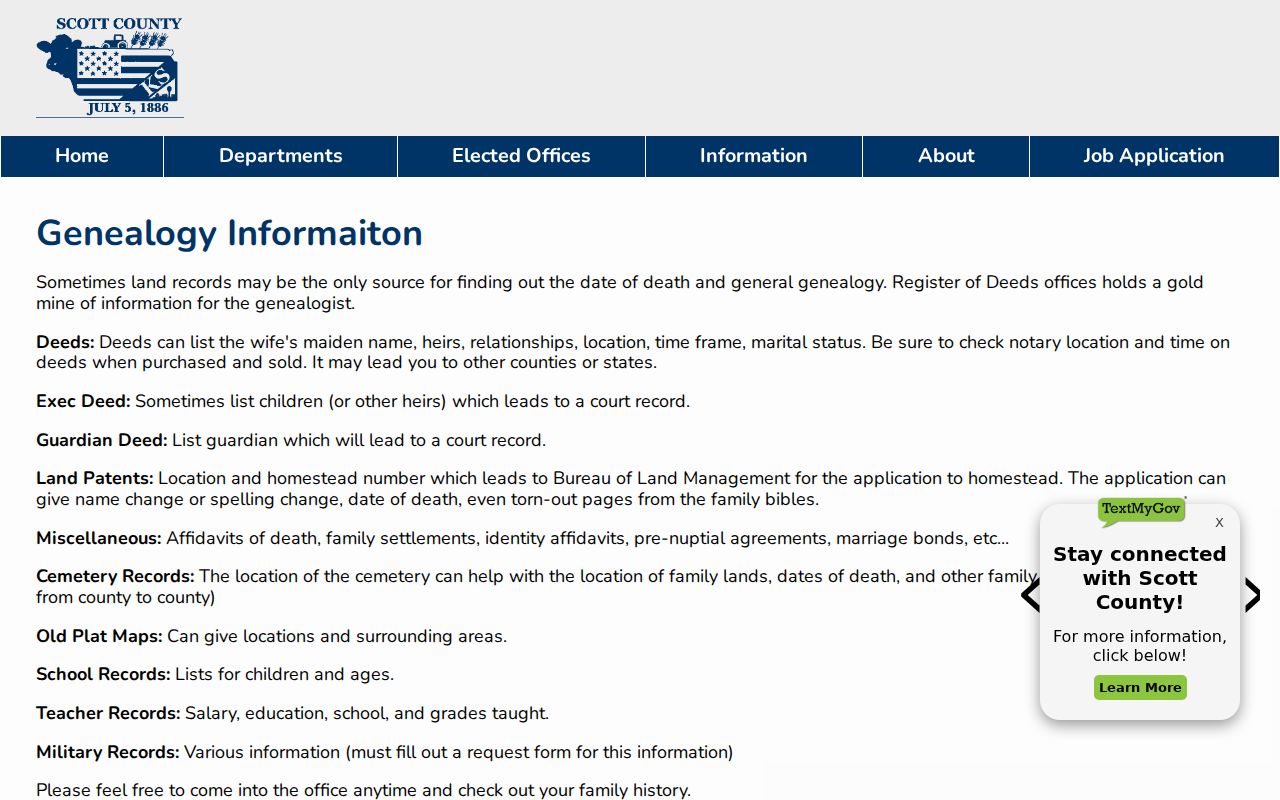
The office reports that its oldest records are elaborate manuscripts from 1886. These include federal land patents signed by a President. That long physical history is not the same as online coverage. The county publishes no earliest web-index year and no public deed-image range. Older deed books and manuscript indexes can push a chain of title well beyond any modern parcel display. Patents, executor and guardian conveyances, and family-settlement affidavits often name heirs. Many also spell out family relationships. County genealogy material also points to old plats and cemetery records as leads. Verify each clue against the actual recorded instrument.
The county's genealogy and land-record notes describe these historic clues.
Historic Scott County Land Clues
Once the recorded chain is built, Scott County's physical record trail pairs well with local-history sources. The Kansas Historical Society bibliography lists several items. These include History of Early Scott County, Rosa Dickhut's local history, 1932 historical notes, and a 1937 anniversary souvenir. Clipping files and newspaper microfilm round out the list. Its county profile also links cemetery, post-office, newspaper, bibliography, and archive resources. Former place names can resolve an apparent gap. The state post-office index records Plummer changing to Modoc and Grigsby changing to Grigston. The 1895 census material names Scott City, Pence, Manning, Grigston, Shallow Water, and Modoc. An older deed or newspaper notice may use one of those names. It may not use a modern mailing place. Treat each historic source as a clue. Then confirm the land through the legal description and county index. The University of Kansas archives catalogs a Scott County land-company collection dated 1900 through 1902. It may add context for early transfers, settlement, or subdivision history. But it is not the county's present title index. Kansas residents can seek newspaper microfilm through a local library's interlibrary-loan route. A notice may point to an estate, sheriff action, or plat reference. That reference can then be requested from the proper office.
Legal Descriptions Control the Search
Scott County records describe a city lot by addition, block, and lot, or rural land by section, township, and range. Pull the full legal text from the newest deed. Street names change. Parcels split. A replat can revise the whole lot framework. The county office indexes by legal description as well as by name. That makes the description the best cross-check for people sharing a name, entity transfers, and old rural parcels. A city annexation may shift jurisdiction without ever rewriting the deed description.
Scott County Recording Rules
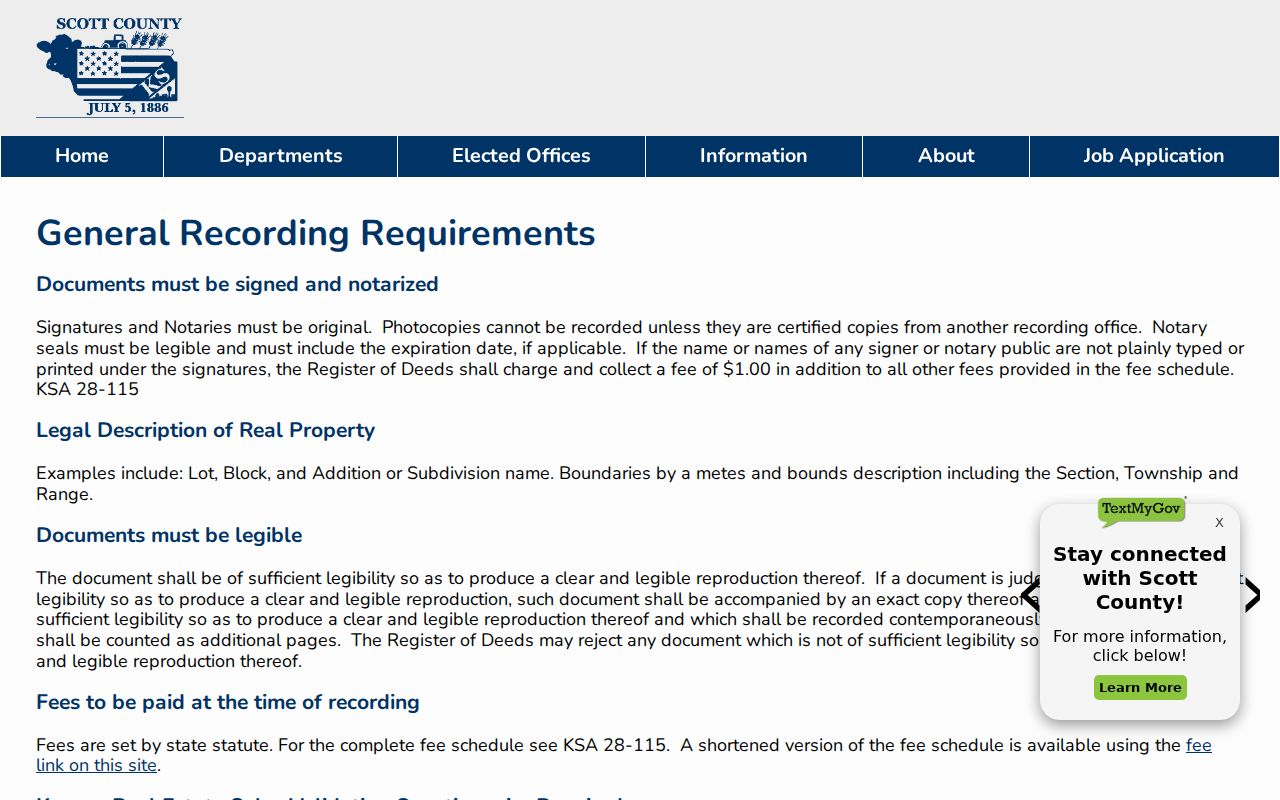
Any document presented for recording must be legible. It must also carry the required signatures, acknowledgment or notary information, and legal description. Kansas conveyances and affidavits of equitable interest generally need a Real Estate Sales Validation Questionnaire. Alternatively, they may cite a stated statutory exemption. That questionnaire is not an open record in Scott County. Military DD214 discharge records are restricted too. Neither should be expected through a routine records request. Check the county recording requirements before filing, because a rejected document never enters the chain of title.
The linked requirements page shows the conditions the office reviews.
Scott County Mortgage Records
The Scott County instrument list runs well past deeds. Mortgages, trust instruments, contracts for conveyance, assumptions, modifications, trust indentures, and fixture filings all appear in the recording books, alongside assignments, subordinations, releases, and satisfactions. Most of these add encumbrance context rather than conveying fee ownership. Read them for what they are.
Lien records add another layer. Federal tax, Kansas employer tax, agister, artisan, truck-registration, and veterinary liens all show up in county property records, but a true mechanic's lien against real property belongs with the Clerk of District Court instead. A thorough review may need both courthouse routes. A lis pendens signals pending litigation, not its outcome.
The Scott County instrument list shows the breadth of recorded land documents.
Court Filings Beside Land Records
Some title events live outside the land-recording office. Scott County files a true mechanic's lien against real property in a specific spot. That spot is the Clerk of District Court. Foreclosure pleadings, judgments, probate orders, and later case events also matter. They explain why a sheriff, executor, administrator, guardian, or trustee signed a conveyance in the deed records.
Kansas Courts CaseSearch is the statewide case-search route now. It replaced the older public-access system in 2025. Its online reach is narrower than a courthouse terminal. Sealed or sensitive material stays excluded either way. When a recorded instrument names a party or case reference, search by that first. Request the specific docket item from the court if it is not online.
The 25th Judicial District accepts written, in-person, phone, and fax copy requests. Copies run $0.25 per page. Certification adds $1 beyond the stated attorney-copy rule, and the office allows three business days. Confirm the current charge before ordering. Keep perspective on what a filing proves. A pleading, lis pendens, or docket entry shows an event or allegation only. Match it with the later order and the recorded conveyance. That establishes the actual title outcome in Scott County deed records.
Scott County Deed Fees
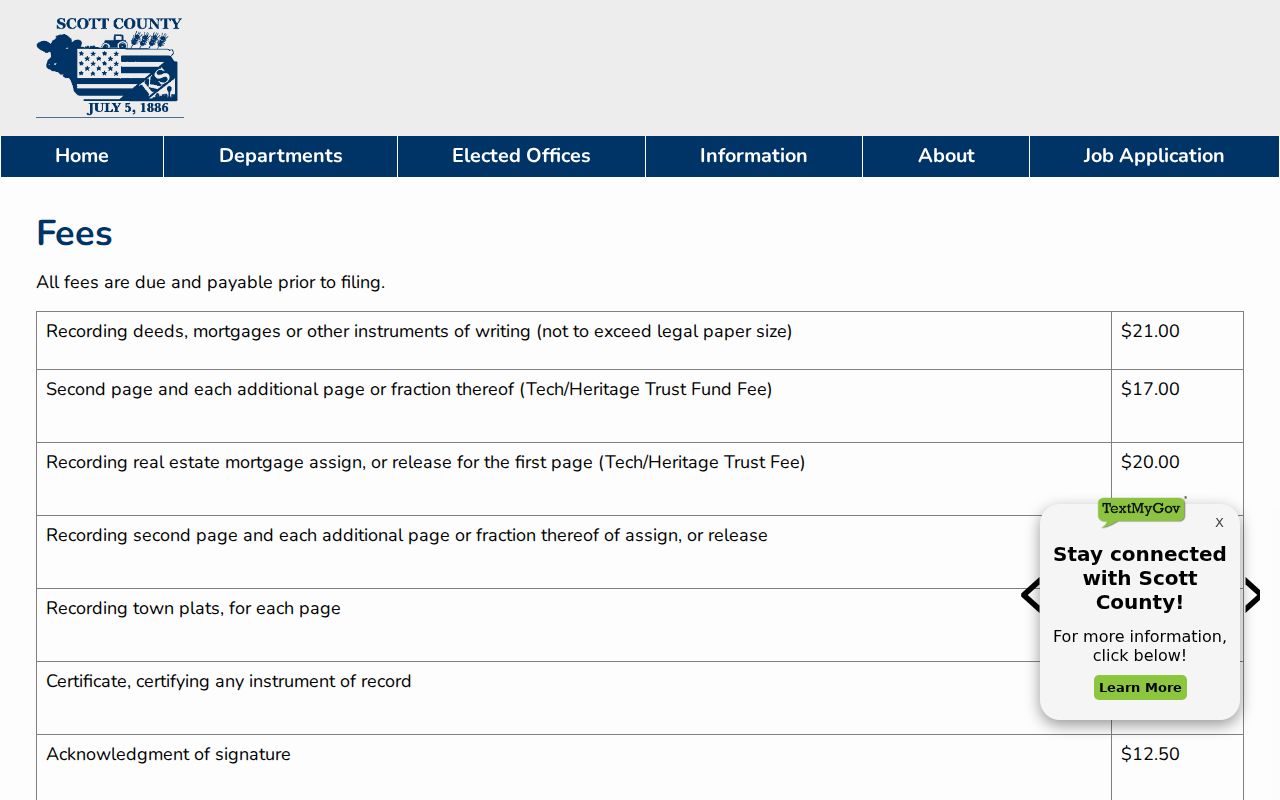
Scott County posts a straightforward recording schedule. The first page of many recorded instruments and mortgages costs $21. Each later page, up to legal size, is $17. A paper survey or plat up to 24 by 36 inches is listed at $32. Larger additional sheets run $20. Lis pendens recording is $5, and federal tax-lien notices or releases cost $32 each.
Fees are due before filing. The page shows no clear revision date. Confirm copy and certification costs with the office directly. Recording fees also sit apart from research charges. They sit apart from court-copy charges and any cost estimate for a KORA request tied to Scott County property records.
Review the current recording fee page before paying or sending a document.
Restricted Scott County Deed Material
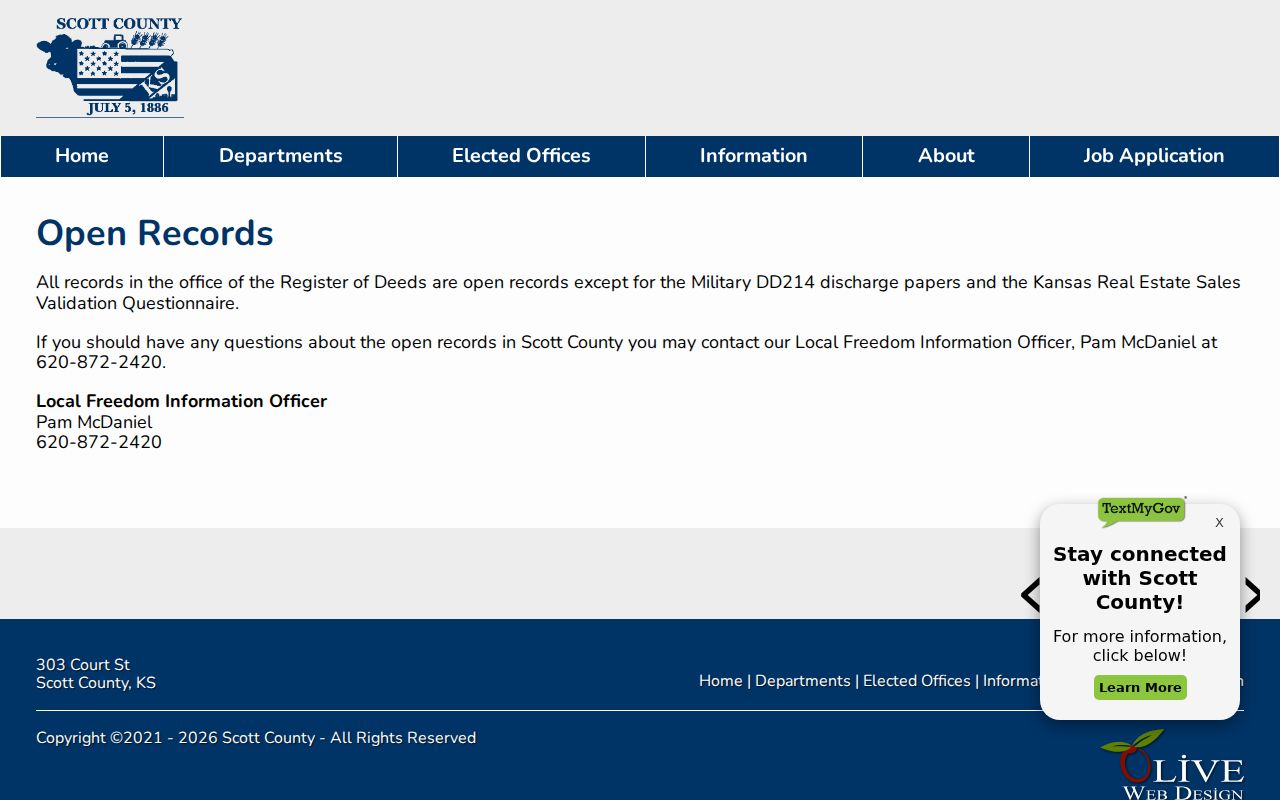
Kansas open-record law does not open every item in a recorder file. Scott County excludes sales-validation questionnaires from ordinary public access. DD214 discharge papers are closed off too. Other records in the county property records system can carry redactions or statutory limits.
A focused request works best. Ask for the deed or the existing index entry. Give the legal description and date range. Request a fee estimate. If the office withholds a separate form, lean on the recorded deed language. Use other lawful documents rather than trying to rebuild protected data.
The county's open-records page states those local access limits.
Obtain a Scott County Deed
Request a plain or certified copy from the recording office by book and page. Include the legal description. When the reference is unknown, supply the parties, date range, and document type so staff can locate the index entry. In-person, phone, email, and written routes all matter here. The county publishes no public online image archive of Scott County deed records.
Remember what a certified copy proves. It verifies the office copy, not clear title. Electronic recording through Simplifile or CSC serves submitters filing documents, and it does not create a public deed search.
Recorded, not guaranteed. Scott County deed records show what was accepted and indexed. They are not a title opinion and cannot rule out an unrecorded interest.