
Read Scott County Tax Records
Two offices split the work. The Appraiser sets appraised value, classification, and assessed value. The Treasurer bills, collects, and distributes, so read each field with its year and its keeper.
| Field | What It Shows | Where |
|---|---|---|
| Appraised or use value | County value as of the assessment date | Appraiser |
| Classification and assessed value | Statutory class and taxable portion | Appraiser |
| Tax year and account type | Year plus real estate, mineral, oil/gas, or other account | LGIS tax search |
| Bill, balance, and payment | Amount billed and collection status | Treasurer |
| Notice and appeal record | Value notice and review timing | Appraiser |
Appraised value is not assessed value. It is also not the bill. Kansas applies a class rate to appraised or use value to reach assessed value, and levies plus other billing rules then shape the final tax bill.
Scott County Tax Search Fields
The county LGIS/Aumentum portal offers its own Tax Search screen. That screen sits apart from the general parcel search and carries the fields a Scott County property tax inquiry needs.
| Field | Use | Check |
|---|---|---|
| Tax Payer's Name | Find accounts tied to a payer | Do not treat payer as deed owner |
| Tax ID | Open a known account | Keep it with the parcel ID |
| Tax Year | Separate annual records | State the year with every amount |
| Address and ZIP | Find a known site | Confirm legal description |
| Property Type | Separate account classes | Surface and mineral interests can differ |
Choices include Real Estate, Severed Mineral, Personal Property, State Assessed, Oil/Gas, and 16/20m. The portal publishes no online history depth or update date, so confirm coverage with the office before relying on it.
Find a Scott County Tax Bill
Start with the parcel search, never a guessed name. The parcel number and legal description make any handoff to the Treasurer reproducible.
- Find the parcel by address, parcel ID, or legal description and save the exact identifiers.
- Open Tax Search and select the tax year and correct property type.
- Ask the Treasurer to confirm the statement, balance, receipt, or payment history for that year.
- Return to the Appraiser for value, class, notice, correction, or appeal questions.
- Assessed value
- The appraised or use value after the statutory class rate is applied.
- Mill levy
- The local levy applied in the property tax calculation.
- Appraised value
- The county's value estimate for the assessment date, or agricultural use value where applicable.
- Tax lien
- A recorded claim tied to unpaid tax, distinct from an ordinary bill field.
Scott County's Annual Tax Calendar
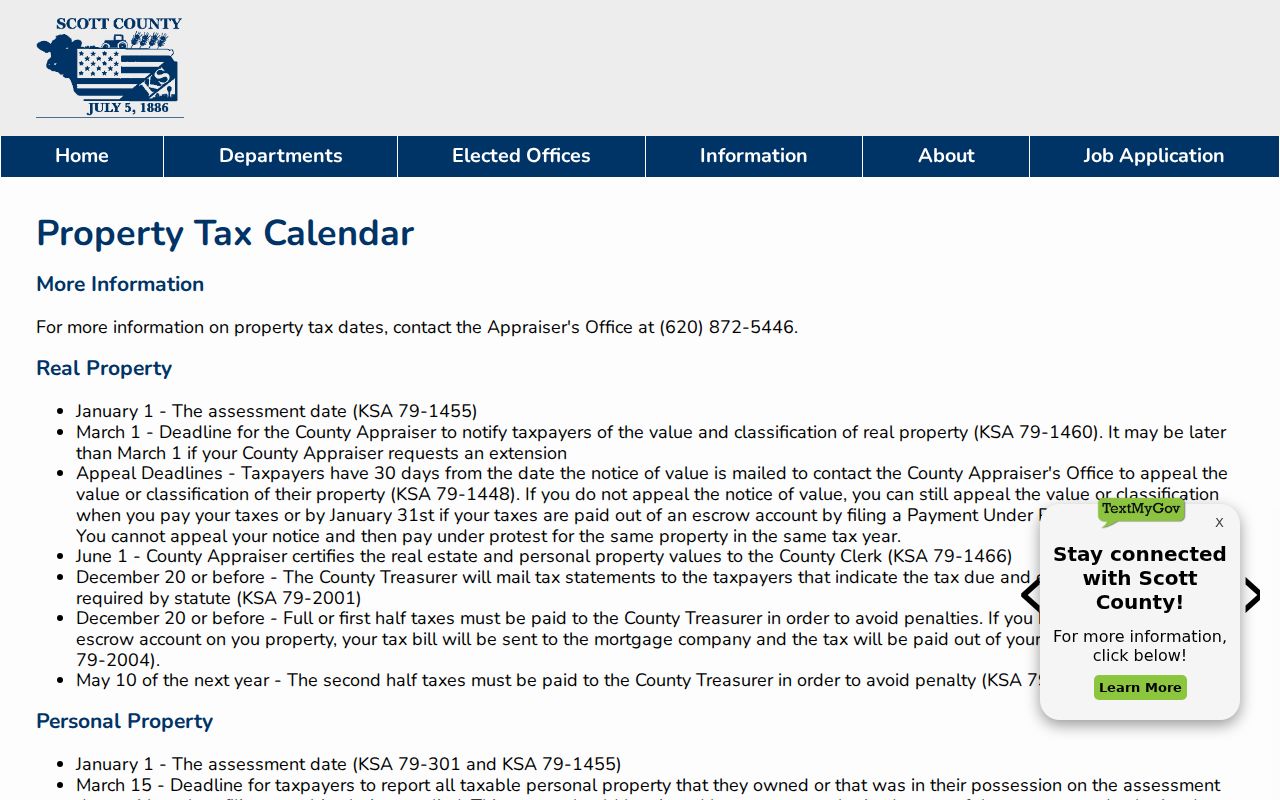
The assessment date is January 1 under K.S.A. 79-1455. Real-property notices ordinarily go out March 1, though that date can be extended. That mailing starts the appeal clock. Values are certified to the County Clerk on June 1. Pay the first half or the full amount by December 20. The second half comes due the following May 10. A mortgage company may receive the escrow statement, and payment-under-protest timing runs on its own schedule, so confirm that window with the offices directly.
The county's property tax calendar lays out these points.
Payment Status in Scott County
Label every balance before you trust it. A Scott County tax account may show a current bill, a first-half balance, a second-half balance, a paid receipt, or a delinquent account. The Treasurer collects ad valorem property taxes and distributes receipts to the taxing entities. The office also accepts credit-card payments and offers monthly arrangements for both current and delinquent taxes. Those services touch collection only. They never change the Appraiser's class or value.
Escrow adds one more wrinkle. The county calendar has the Treasurer send the statement to the mortgage company when taxes run through escrow. A missing paper bill is not proof of no tax. An owner should compare the Treasurer's statement with the mortgage servicer's account. Ask for the tax year, the statement, and the payment status. A general total is not enough.
The Treasurer publishes no online tax-sale list, redemption roster, auction calendar, or searchable delinquent-parcel inventory. No single field proves a delinquency. A sale entry, low assessment, mortgage, or lien viewed alone should never be read as an unpaid balance. Request the Treasurer's record for the named year. If another filing points to collection or foreclosure, verify its date and final outcome through the recorded or court record.
Scott County Assessment Classes
Each class carries its own rate under K.S.A. 79-1439. Residential sits at 11.5 percent. Vacant lots carry 12 percent. Commercial and industrial property assesses at 25, agricultural land at 30, public utilities at 33, and a residual class at 30. Agricultural use value comes from a productivity formula, not a direct sale comparison. A farm residence generally gets residential treatment. Agricultural improvements assess at 25 percent. Fix the class before comparing appraised with assessed value, and never call a class rate a tax rate.
Match Scott County Tax Values
Four numbers can surface in a Scott County tax inquiry. Each answers a different question. Market or appraised value is the Appraiser's estimate for the assessment date on most nonagricultural real estate, while agricultural land runs on a productivity formula instead. Assessed value applies the statutory class rate. The tax bill folds in assessed value, local levies, and any billing adjustments. A sale amount is just one transaction clue.
Keep the label and year beside every number. The portal offers sale-date, sale-amount, and appraised-amount filters. One caution applies. The Real Estate Sales Validation Questionnaire that may accompany a transfer is not an open record. A displayed sale amount may not tell the whole consideration story, so take the conveyance to the Register of Deeds and valuation questions to the Appraiser.
Tax maps and appraisal fields update on different schedules. The county's map disclaimer warns that appraised and tax information may not match the same year's values. Give both offices the same parcel ID, legal description, and year when screens conflict. Ask each office to name the field it maintains. Never merge the figures into one unsupported property value.
Scott County's 2026 Value Signal
Scott County's new market study takes effect January 1, 2026. Residential inflationary trends run from 3.2 to 6.35 percent. Commercial and industrial values hold steady, while vacant-lot increases reach up to 6 percent. A single parcel can still move against these countywide numbers because of comparable sales, property changes, or corrections to the property records.
Treat the study as trend evidence, not a forecast for one tract. For any Scott County assessment question, the controlling documents are the parcel's class, its notice, and the effective year. The Appraiser can explain the comparables and adjustments behind an individual notice.
Appraiser and Treasurer Roles
Two courthouse offices split the property tax work in Scott County. The Scott County Appraiser sits at 303 Court Street in Scott City. The office lists 620-872-5446 and scappraiser@scottcountyks.com. It values and classifies property. It also fields inspection and informal review questions, and it publishes its research charges.
The Treasurer sits in the same courthouse and lists 620-872-2640 and sc_county_treasurer@scottcountyks.com. It handles ad valorem bills, collections, and distributions. It also takes credit-card payments and monthly arrangements for current or delinquent taxes. Asking the right office first saves you time. You avoid pressing the collector to defend a value, or the appraiser to certify a payment.
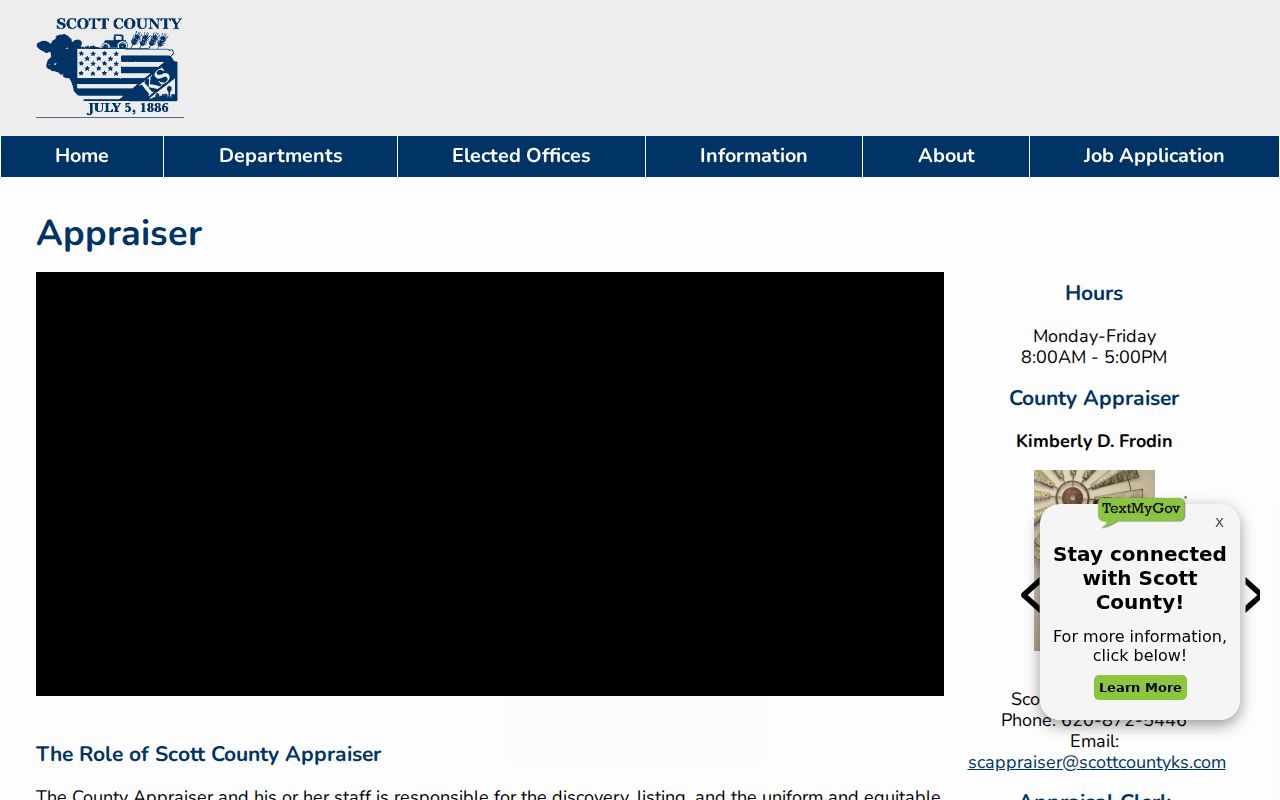
The official Appraiser page describes valuation, inspection, and review work.
Request Historic Scott County Taxes
The portal does not say how many past tax years it covers. For an older inquiry, request existing records by parcel and year: the assessment notice, class, appraised and assessed values, corrections, and the tax statement. Ask also for the payment record.
A Kansas Open Records Act request should name the office, the record category, the parcel ID, the legal description, and the years wanted. It should also state your preferred format. Ask for a fee estimate up front. The office is not required to build a custom history or analysis. Precise record categories work far better than a broad request for everything on a parcel.
Scott County Inspection and Research
The Appraiser expects to inspect 17 percent of real property each year. Re-examination follows on a six-year cycle. Partially complete construction gets valued by its percentage complete on January 1. These are assessment-process rules. They are not proof that a parcel card will show a recent inspection date. If a building fact looks wrong, ask which assessment year and field produced it.
Research at the office carries posted charges. The Appraiser lists $2 per copy or item. A simple query costs $10 plus printed-page charges. In-depth research runs $25 per hour, prorated by half-hour. Website research access runs $300 per year with an approved license. Confirm each amount and the scope before requesting work. These are Appraiser research fees. They are not a title search fee and not a Treasurer payment charge.
A strong request names the parcel. It also names the assessment year, the disputed field, and the existing record you want. For a class question, ask for the value and classification notice. For a change question, request the available correction or inspection record. For a payment question, switch to the Treasurer and ask for the statement or receipt.
Challenge a Scott County Assessment
A real-property owner must request the ordinary informal meeting within 30 days. The clock starts when the value notice is mailed. Personal-property appeals are due by May 15. Bring the notice and the parcel identification. Also bring your class question, recent property-change facts, and comparable evidence to the Appraiser.
Payment under protest is a separate route used with the tax payment itself. The county warns that the notice appeal and the payment-under-protest route cannot both be used. They cannot cover the same tax year. Verify current timing and procedure before choosing either path.
Watch the mailing date. Scott County's ordinary real-property appeal period runs 30 days from the notice mailing, not from the day a portal result is viewed.