
Scott County Value Measures
Read any Scott County property value by source and date. The Appraiser estimates market value for most non-agricultural real property. Agricultural land gets productivity-based use valuation instead. Kansas classification rules then convert an appraised or use value into assessed value. A sale field describes a transaction. The Treasurer's statement reflects the later billing process. Keep those figures apart when comparing values.
| Value | What It Is | Where |
|---|---|---|
| Market or appraised value | County estimate as of an assessment date for most non-agricultural real estate | Appraiser and parcel record |
| Assessed value | Appraised or use value after the statutory class rate | Appraiser assessment record |
| Sale amount | A portal transaction field that may not reveal full consideration | Parcel portal, checked against the deed |
| Market-study trend | County or property-class signal, not a parcel appraisal | Annual county market study |
Assessment rates differ by class in Kansas. Residential property is generally assessed at 11.5% of appraised value. Commercial and industrial property sits at 25%. Agricultural land sits at 30% of use value. Vacant lots sit at 12%. These percentages are assessment rates, not tax rates. Always carry the applicable class and year alongside the number. Remember that a mixed farm may contain a residence or agricultural improvement treated under a different class.
Scott County's 2026 Market Study
The 2026 Scott County market study took effect January 1, 2026. It reports a residential trend range of 3.2% to 6.35%. Commercial and industrial property showed stability. Vacant-lot increases ran up to 6%. Those are class-level findings for the whole county. Not every house rose by the high end. Not every commercial parcel held perfectly still.
An individual property value can differ. Causes include comparable sales, corrections, property changes, or a property's specific characteristics. The study states that owners were notified in March. They could request an appeal within 30 days of mailing. Detailed market-study analyses are kept at the Appraiser's office. The appeal process belongs with property-tax records. For valuation research, the key point is simple. Label the trend as county-level evidence rather than proof about one parcel.
The Scott County assessor's office page is the right contact for a parcel-specific appraisal question. It will not predict what a property records trend means for your next sale.
Find a Scott County Value
The county-linked LGIS/Aumentum portal exposes owner, Quick Ref ID, address, parcel ID, sale-date, sale-amount, appraised-amount, legal, subdivision, class, and physical search controls. The portal publishes no card-level update timestamp. Treat any figure there as a dated lead. Ask the Appraiser to confirm the field and assessment year before relying on it.
- Search by address, parcel ID, Quick Ref ID, subdivision, or S-T-R. Use fewer fields if the first search is too narrow.
- Copy the displayed label, amount, property class, assessment year or effective date, parcel ID, and legal description.
- For a sale reference, locate the recorded deed through the Register of Deeds and keep execution and recording dates distinct.
- Ask the Appraiser what public comparable-sales analysis exists. Do not substitute a statewide ratio study for a parcel appraisal.
- Appraised value
- The county's estimate for the assessment date on most non-agricultural real estate.
- Assessed value
- The appraised or use value after the Kansas class rate is applied.
- Use value
- The productivity-based basis used for agricultural land.
- Sale amount
- A transaction field that needs context from the recorded conveyance.
Agricultural Value in Scott County
Agricultural land is not valued like a Scott City home. Kansas applies productivity-based use value to agricultural land. The state's property-tax materials also distinguish agricultural improvements and a farm residence. These may fall under different classes. Record the class attached to each portion before comparing amounts.
For a rural tract, begin with section, township, range, and acreage. Preserve any separate surface, severed-mineral, or oil/gas record. Soil, water, and farm support structures may supply context. But they do not replace the county's classification or valuation record. If a class or use code is unclear, ask the Appraiser why it was assigned.
Note: The portal's property class and LBCS codes describe assessment or use, not zoning approval.
When Scott County Values Change
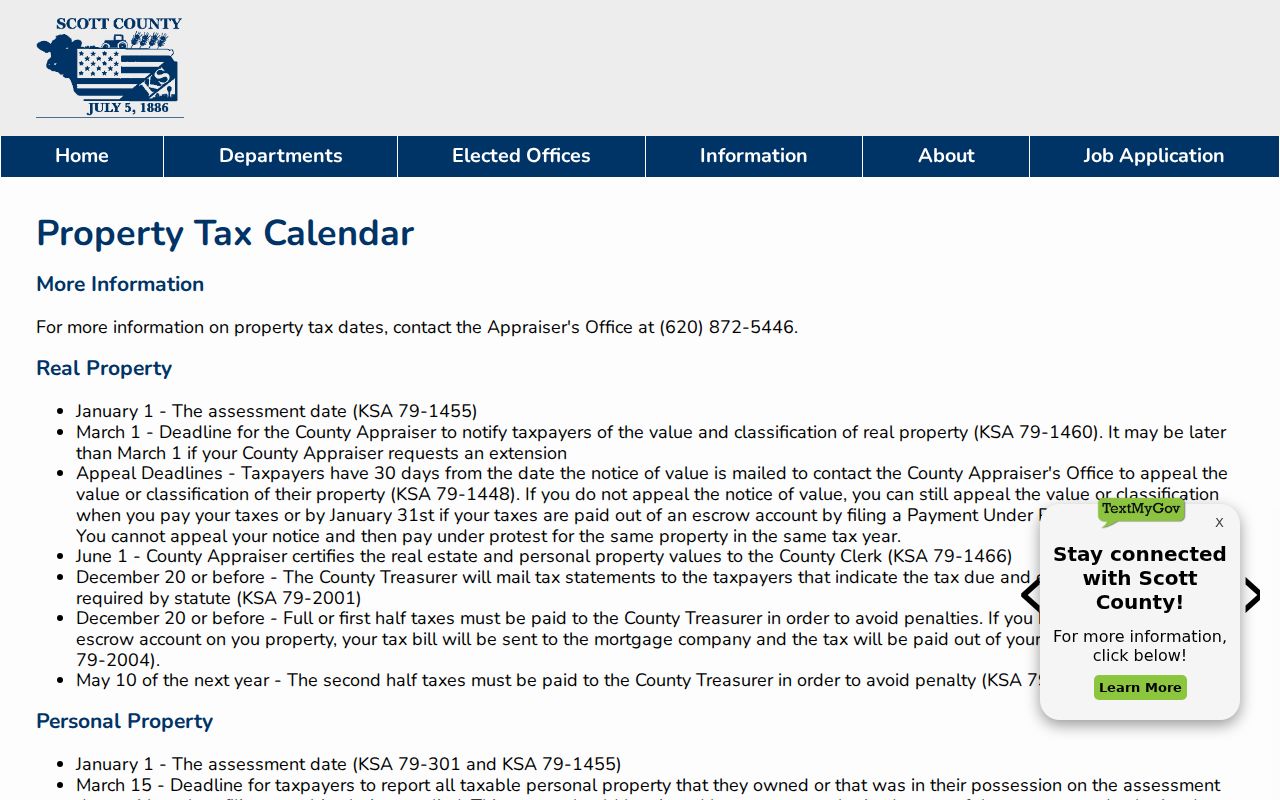
The annual calendar fixes the assessment date on January 1. The county's property-tax calendar then tracks notices, appeal steps, certification, and payment dates. A sale after that date changes nothing. It does not retroactively become that year's appraised value. Improvements, corrections, classification changes, and later market evidence can shift the next cycle.
Read the year beside every figure. The parcel portal publishes no card-level update interval. A current value should therefore include the date it was checked.
Recorded Sales Need Context
The portal offers sale-date and sale-amount search controls. But a displayed amount is not always the full market story. Kansas real-estate sales validation questionnaires are restricted on the county's open-records page. Consideration may be absent or need explanation. Use the Register of Deeds to identify the actual conveyance and legal description.
A deed can confirm the parties, recording date, and land transferred. It does not automatically supply an arms-length comparable. Family transfers, estate deeds, corrections, sheriff deeds, and partial-interest conveyances can all produce misleading comparisons. The Appraiser is the proper office to ask. Ask how a sale was used in mass appraisal.
Document a Scott County Value
A useful valuation note records the source office, exact field label, and amount. It should also capture the property class, assessment year, check date, parcel ID, and legal description. Add the deed reference only when discussing a transaction. This evidence card prevents a later reader from treating an old portal amount as current. It also keeps a market-study trend from being mistaken for an individual appraisal.
If the live portal is unavailable, ask the Appraiser for the existing assessment record. You can also request a value or classification notice. Request electronic copies where available. Get a fee estimate before research begins.
Limits of Scott County Values
Start with what the Appraiser's number actually is: a mass-appraisal value built for county assessment work. It is not a guaranteed selling price. It is not a private appraisal, a construction estimate, or a tax bill. The Treasurer handles levies, exemptions, credits, and billing rules only after assessed value is set. Parcel-card and classification questions go to the Appraiser at 620-872-5446 or scappraiser@scottcountyks.com. Buyers, sellers, and estates often need an independent appraisal tied to a specific effective date and purpose. That opinion should stay separate from the county record. The Kansas ratio-study archive offers comparison context through 2025. But it predicts nothing about any single Scott County parcel.
Treat the physical fields in the assessment portal with restraint. Style, bedrooms, bathrooms, basement, year built, and structure or function codes exist to support mass appraisal. Some entries are generalized, stale, or coded purely for valuation. A city permit or inspection record beats the portal for evidence of construction work. For acreage and boundary claims, a deed or survey is stronger. Compare like with like, too. An Original Town lot, a productivity-valued rural tract, and an industrial parcel do not share a valuation method or market evidence. Preserve property class and effective date before comparing any amounts. When a figure shifts, ask whether market analysis, a correction, a physical change, or reclassification caused it. Do not assume the parcel sold or the tax rate moved.
The county's inspection cycle explains many changed numbers. Physical review and data maintenance sit within the Appraiser's valuation duties. A new structure, a demolition, a remodel, corrected square footage, or a class change can all move the assessment record without a sale. If a physical field looks wrong, bring the parcel ID, legal description, assessment year, and the disputed field. Ask what source and inspection date support the entry instead of guessing a replacement amount. Comparable-sales work demands the same discipline. A portal sale filter can surface candidate transactions. But it cannot prove they were open-market, arm's-length sales of genuinely similar land. Weigh property class, location, use, date, lot or acreage, and improvements. Family transfers, estate instruments, sheriff deeds, partial interests, and correction deeds may need exclusion or explanation. The Appraiser can identify which public market-study material exists and how a given transaction fed into mass appraisal.
Population figures are broad context, nothing more. Scott County counted 5,151 people in the 2020 census. The July 2025 estimate came in at 4,815. Those countywide numbers may frame demand, but they cannot value a house, farm, vacant lot, or industrial site. Keep demographic change separate from the 2026 class trend and from any parcel-specific appraisal evidence.
An assessed value must always include its class and assessment year before it is compared with another figure.
Value versus price. A Scott County assessed or appraised value is not a promise of what the property will sell for. Use a qualified private appraisal when a parcel-specific opinion is required.