
Scott County Ownership Sources
Different Scott County sources play different roles in a former-owner search. The Register of Deeds keeps land-record manuscripts dating back to 1886. The county publishes no online grantor-grantee index. The office counter and email remain the dependable routes. The county parcel portal supplies a current assessment clue. It also offers the legal-description bridge that carries you into the deed books.
| Source | Years It Covers | Where Held | What It Shows |
|---|---|---|---|
| Deed index and instruments | 1886 to present | Register of Deeds | Grantor, grantee, dates, instrument reference, legal description |
| Historic plats and patents | Varies by record | Register of Deeds and federal archives | Original lots, additions, land entries, and parcel changes |
| Estate and court filings | Case dependent | District Court and CaseSearch | Authority behind executor, administrator, or guardian transfers |
| Newspapers and local history | Many papers from 1854-1922 online | KSHS and Scott County Library | Dates, place names, estate notices, and research leads |
For a recent chain, open the county parcel search and copy the parcel ID and exact legal description. Then ask the recorder for the newest conveyance. Ownership from the nineteenth or early twentieth century usually takes an office or archive search. A street address alone is weak. Old instruments rarely carry street addresses. They identify land by subdivision, block, and lot, or by section, township, and range.
The 1886 Record Starting Point
Scott County was organized in 1886. The recorder identifies that year as the start of its manuscript holdings. That local fact sets a clear limit on any former-owner search. Earlier ownership may require federal land patents, territorial material, or an archive lead. So another county deed book is not the answer.
The recorder's genealogy notes widen the trail. A deed can carry a wife's maiden name, marital status, heirs, and family relationships. It can also list a notary's place and date. Executor and guardian deeds can point to children, guardianships, or court proceedings. Such clues help separate people with similar names. Each claim still needs the instrument.
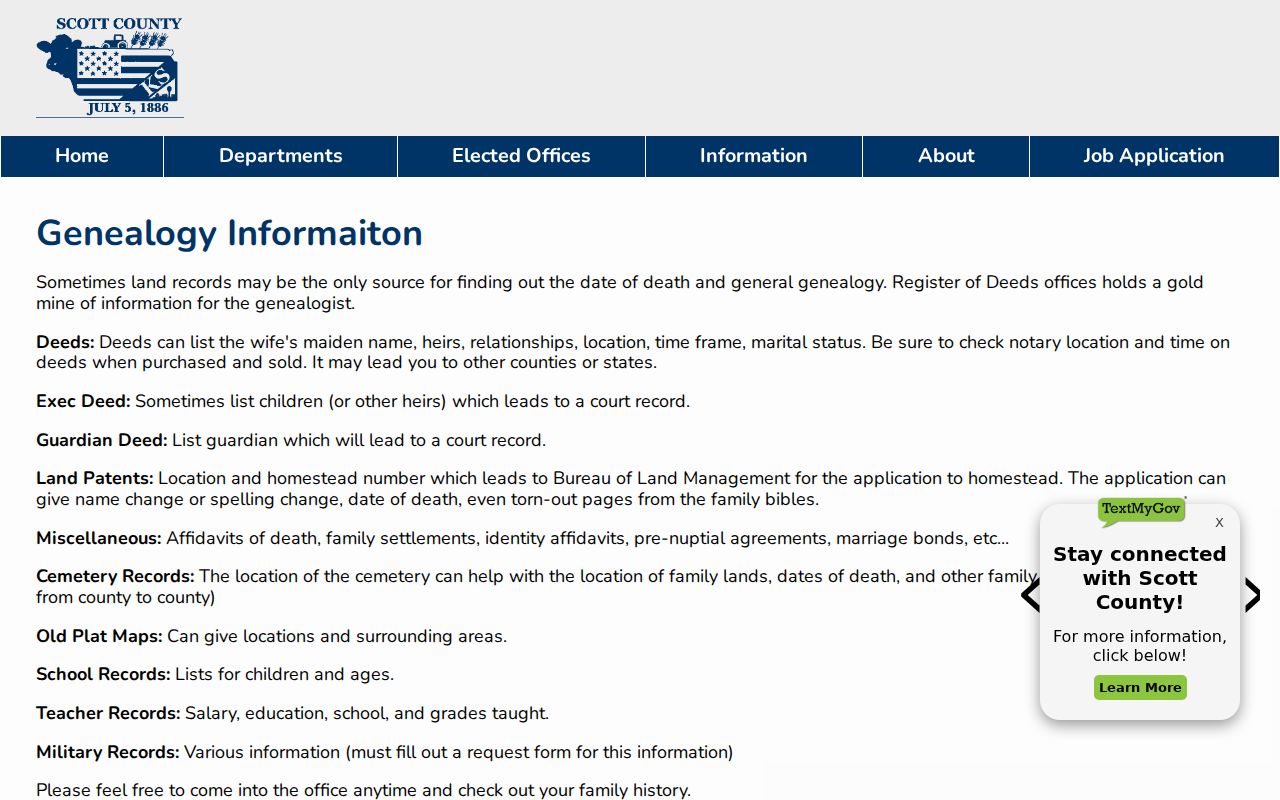
The county's official research route appears above. It replaces neither a copy of a deed nor a certified title search.
Reconstruct Scott County's Deed Chain
Work one legal description backward. The newest assessment clue is only a starting point, and the portal name is not certified title. Find the latest recorded conveyance that connects that clue to a named grantee. That deed's grantor becomes your next search.
- Record the parcel ID, exact legal description, subdivision or S-T-R, and the date the parcel portal was checked.
- Ask the Register of Deeds for the latest deed matching that description. Capture the grantor, grantee, execution date, recording date, and book/page or instrument number.
- Search the latest grantor as a prior grantee. Confirm that the legal description matches before adding that instrument to the chain.
- Repeat the process, noting correction deeds, transfer-on-death deeds, sheriff deeds, affidavits, and estate-related instruments that explain changes.
- Grantor and grantee
- The conveying party and the receiving party named in a deed.
- Chain of title
- The ordered sequence of instruments affecting ownership of the same land.
- Legal description
- The recorded land description that ties old and new records together despite address or parcel changes.
Scott County Estate Transitions
Ownership did not always change by ordinary sale. Executor, administrator, guardian, trustee, family-settlement, affidavit, and transfer-on-death language can each explain a transition. When a deed points to probate, guardianship, foreclosure, or quiet title, search Kansas Courts CaseSearch. Online coverage varies. Sealed or sensitive material may be withheld.
With a case number, party, document type, and date, the Scott County District Court can pull a specific public filing. A court order explains authority or a dispute. It does not prove a land instrument was recorded. Match the court event to the Register of Deeds record and legal description before adding anyone to the chain.
Note: A taxpayer or mailing contact listed on the parcel record is not automatically the fee owner of the property.
Old Scott County Place Names
Historic geography can unstick a stalled former-owner search. The Kansas Historical Society post-office index lists places such as Arcola, Friend, Manning, Pence, Shallow Water, and Zenobia. It also records Plummer becoming Modoc and Grigsby becoming Grigston. An old deed, newspaper, or family note may use one of those names instead of a modern address.
The 1895 census material places Scott City, Pence, Manning, Grigston, Shallow Water, and Modoc in the county's historic geography. Search old newspapers by date and place. Carry any deed reference back to the recorder. Estate papers and plats go there too. Kansas residents have another option. Newspaper microfilm is available through a local library's interlibrary-loan service.
Plats Connect Previous Owners
A chain may seem to snap. Replatting, splitting, combining, and renaming all do it. Copy the exact addition, block, lot, plat reference, acreage, and section-township-range language from every instrument, because "Original Town (Scott City)" and a later addition are not interchangeable labels. The recorded plat shows how an older tract became newer lots.
Rural parcels need extra care. A surface parcel, mineral interest, access easement, and oil or gas interest can follow different record paths. The parcel portal's tax categories include severed mineral and oil/gas searches, but title claims still come from recorded instruments. For an early lead, the University of Kansas archive holds a Scott County land-company deed collection from 1900-1902. It is context, not the current deed index.
How Far Scott County Records Reach
The Scott County recorder holds recorded manuscripts reaching back to 1886. Ownership before that year is still traceable. A federal patent, homestead reference, historic plat, archive collection, or newspaper lead can carry the chain earlier than the county books. Record the patent location and federal reference. Then verify how that land first entered the Scott County deed chain, since no universal chain length or online cutoff fits every parcel.
Copies come from the recorder's office. Visit 303 Court Street in Scott City, call 620-872-3155, or email scregofdeeds@scottcountyks.com. Ask for a record by legal description, party, date range, and instrument type. The official fee page lists copy and certification charges. Confirm the current total before ordering.
A focused request works better than a broad one. Deeds, mortgages, releases, liens, easements, plats, affidavits, lis pendens, and sheriff deeds each deserve separate treatment. Give a reasonable date range. Request the index reference plus an image when available. Kansas Open Records Act procedures cover existing public records, though an office need not create a title report or research a conclusion for you.
Keep a chain worksheet as you move back. Each row should capture the parties, instrument type, execution and recording dates, reference number, and exact land description. Add an evidence label too. Useful labels include assessment clue, recorded instrument, court filing, and archive lead. Labels keep conflicts visible. A correction deed or later affidavit may resolve a spelling error, while a plat may explain why acreage or lot wording changed.
Recording requirements add another quality check. Scott County accepts lot, block, addition, and subdivision descriptions as well as metes-and-bounds descriptions tied to section, township, and range. Compare wording character for character when tracing owners. A surname alone is no chain link. The office requirements also address signatures, acknowledgments, legibility, and sales-validation material, though the validation questionnaire itself stays closed to public inspection.
Early patents can push the search deeper. Capture the patent location, homestead number, federal reference, and any later name variation. Then find the first county instrument using the same land description. Matching land is the test. The recorder's genealogy material points to federal land resources, cemetery records, old plats, and family documents. A presidential signature or archive catalog entry adds historical context. Only matching conveyances show how the tract moved.
Newspaper work starts with place and date. Search Scott City first. A historic community name works too, especially around the recording, probate, foreclosure, or platting period. An estate notice may identify a case. A land advertisement may supply an addition or acreage clue. Carry those details to the District Court or Register of Deeds, since a newspaper statement is never a recorded transfer.
Prior owners should be listed only after the legal description joins each deed. Previous owners inferred from names alone remain unverified leads.
Lawful use. Former-owner research supports house history, estate work, and property diligence. Never use names or addresses to stalk, harass, or expose a protected person.